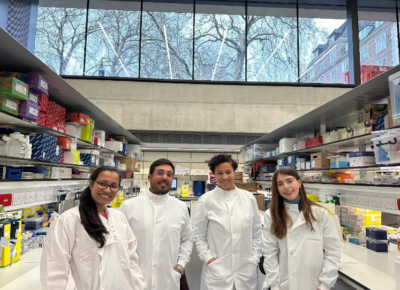
Building a new thymus research programme at the Zayed Centre for Research into Rare Disease in Children (left to right): Dr Zainab Golwala, Dr Juan Moises Ocampo Godinez, Dr Alexandra Kreins (Group Leader), and Ms Grace Evans.
Alexandra Kreins, Consultant in Paediatric Immunology at Great Ormond Street Hospital for Children and Group Leader at the UCL Great Ormond Street Institute of Child Health, London
A 5-year grant of £2.1M from the Wellcome Trust will support research that is especially important for babies born with severe immune deficiencies, including those without a functioning thymus (athymia), who are vulnerable to life-threatening infections from the very start of life. For these children and their families, early diagnosis and timely access to the right treatment can make a life-changing difference.
The thymus is a small but vital organ that plays a crucial role in the immune system. It is where a type of white blood cells, called T cells, develop and are trained to protect us from infections. In the thymus, T cells learn to recognise harmful germs, while also learning not to attack the body’s own tissues.
This process is known as immune tolerance. If the thymus does not form or function properly, this training goes wrong, resulting in miseducated T cells that fail to fight infections effectively, leading to immunodeficiency, and T cells that may also attack the body itself, causing autoimmune disease.
When the thymus does not develop or function properly, children can be born with severe immune problems. In the UK, athymic babies (those born without a functioning thymus) can now be identified early through the SCID newborn screening pilot programme. This is a major advance, as early diagnosis allows life-saving treatment with thymus transplantation to be offered before severe complications develop. Parents of athymic children identified through newborn screening consistently highlight how vital early diagnosis is in keeping their child safe. Many also emphasise the importance of getting the right diagnosis quickly, so their child can be referred for thymus transplantation without delay. As one parent shared in our research, “If our child hadn’t had that newborn screening, they probably would not be here now”.
Thymus transplantation is a highly specialised procedure for children born without a thymus. In Europe, it is currently only available at Great Ormond Street Hospital (GOSH) in London, UK. More than 80 children have received this treatment at GOSH since 2009. As a consultant and a researcher within the GOSH Thymus Transplantation programme, caring for these children and their families has strongly shaped my research priorities.
Despite its importance, the human thymus remains poorly understood. Because access to human thymus tissue is very limited, much of our knowledge comes from animal models that do not fully reflect how the human immune system works. Thanks to a first Wellcome Trust research fellowship for clinician-scientists (2021-2025), I started building a research programme at the UCL Great Ormond Street Institute of Child Health (ICH) to study the human thymus and thymus-based therapies, such as thymus transplantation. I am now very grateful to have been awarded a second Wellcome Career Development Award, which will support the establishment of a research group at ICH, closely integrated with the unique clinical Thymus Transplantation programme at GOSH.
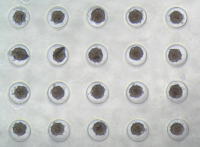
Mini “thymus-like” structures grown from human cells, helping researchers understand immune development and improve treatments for children with immunodeficiency.
My research aims to develop new laboratory models of the human thymus, known as human thymic organoids. These models are built from human thymic cells and may allow us to study T-cell development and immune tolerance in a way that is much closer to what happens in patients. By studying both previously known and newly identified inborn errors of immunity, genetic conditions that affect immune development, we want to understand how specific genetic changes impair thymus function in affected children. We will also study thymic tissue used for transplantation. This will help us to understand how the thymus can re-establish itself after it has been transplanted.
At the heart of this work is a commitment to ensure that scientific advances lead to better diagnosis and improved treatments, with better outcomes and quality of life for people affected by thymic disorders and other immunodeficiencies.
This reflects what families consistently tell us matters most: timely diagnosis, clear pathways to specialist care, and treatments that give their children the best possible start in life.
We have also recently received funding from UCL’s UK Research and Innovation (UKRI) EPSRC Impact Acceleration Account to begin developing ThyNet UK: the Thymus Therapy and Regeneration Network UK. Working with Immunodeficiency UK and the GOSH Thymus Transplantation programme, this initiative will bring together researchers, clinicians, patients and their families. A key aim is to ensure that the voices of patients and families are central in shaping future research and improving care.
I look forward to working together with clinicians, researchers, patients and their families to achieve this.
Posted March 2026.


